Showing posts with label classics. Show all posts

Saturday, November 30, 2013

Thanksgiving with the Alcotts

Currently Reading: Alcott in Her Own Time by Daniel Shealy and The Signature of All Things by Elizabeth Gilbert

"November had come; the crops were in, and and barn, buttery, and bin were overflowing with the harvest  that rewarded the summer's hard work. The big kitchen was a jolly place just now..." 
~ An Old-Fashioned Thanksgiving

Mine was an Alcott Thanksgiving. Yesterday, I spent some downtime reading the opening pages of An Old-Fashioned Thanksgiving, between bits of the biography I started last week. Curled on the couch with my family tonight, we celebrated the holidays and Louisa's birthday with a viewing of Little Women (the 1994 version). The first bars of the opening music floated into the room and the tears were already in my eyes. After two days of feasting and thanking, decorating and Christmas caroling, the time was right to visit the March sisters.
~~~~~~~~~~~~~~~~~~~~~~~~~~~~
A few months exploring books in North Carolina, Corca Duibhne, Ireland, Philadelphia, and Cambridge, I am now back in Concord, Massachusetts with the Alcott family. Just in time for Thanksgiving and Louisa's birthday. This new (to me) biography is a collection of memories, interviews, and memoirs from those who knew her and the Alcott family personally: colleagues, peers, friends, and family. The book is my place to sink into on these cold November evenings, like a mug of hot chocolate, a warm blanket, my cozy refuge from the wind and the chill. I listen with rapt attention to voices and memories that bring me to a Concord I can only imagine and a woman I'm getting to know even better.

 photo 11-29-13_zps9949256c.jpg


I have seen Louisa through the pen of the scholar, her own letters and journals, some of her literary works, and now through the descriptions of those around her. I enjoy viewing her through this alternate lens. New stories abound, new poses are struck, new words are said, forming images of her demeanor and character that didn't find their way into her works. In these memories, Louisa falls onto her bed with a dramatic flop; the barn rings with playful shouts and dramatic soliloquies; she whirls around and curtsies in the lane; she moves her hands to illustrate her words; she covers her pain with humor and "bright flashes of wit." I can finally see her as others did, and she is all sparkling eyes and droll comebacks and noble passion. She is no different from the woman I found in her letters and journals, but these memories serve to reinforce my image of who she was- the dutiful child, the passionate crusader, the witty storyteller, the sharp mind, the Jo-ian personality. Not a perfect person but perfectly herself.

Reading about her through the eyes of others holds both a danger and an advantage. Sometimes those we are close to know us better than we know ourselves. They see the good qualities that we overlook; they recognize the faults we do not see. Louisa was certainly hard on herself, with high expectations she felt she would never attain. (That sounds all too familiar to my ears.) She rarely wrote of her triumphs, except in the humblest of tones. So watching her laugh and clap her hands and keep a room of people in stitches with her witty observations is such a joy.

But even though they can observe us in ways we cannot, those around us often fail to know us fully, only seeing the part we present to them. They aren't privy to the struggles, the fears, the hopes that swirl around unseen in our minds and hearts. So much we keep hidden, even from our closest companions. No matter how close they were to her, most of her contemporaries couldn't know exactly who she was. And time changes our perspectives and our memories. I read these recollections, wondering how much of the writer's descriptions depend upon Louisa's fame and reputation, rather than their own opinions at the time.

These observations both hide and reveal the real Louisa, and I force myself to recognize that I too will never truly know her. But I never stop trying. In this book, once again, I find her, living and breathing, made alive through the words of her contemporaries, the world in which she inhabited and her relationships with neighbors, friends, and peers as real to me as any scene in my own world. When I look up, I am startled not to find her standing in front of me.

Friday, May 3, 2013

Happenings

Currently Reading: The Selected Letters of Louisa May Alcott, The Guynd by Belinda Rathbone, and Life After Life by Kate Atkinson

May is here! Blessedly, my semester is winding down and I am feeling the first breaths of freedom mingling with the scent of spring. My shoulders already feel lighter and I am ready for several weeks of catching up on projects (including some new recipes I'm aching to try) and taking time for reading, walks in the evenings, and ice cream stops with Nate.

Some happenings from the past two weeks:

My seedlings have sprouted! (No picture this time, but I'll get one soon.) The sight of those first little green shoots, poking out of the soil after only several days, gave me such a feeling of awe. Biology aside, there is something entirely magical about the Earth, her resilience and fecundity, the amazing results that come from the harmony of sun, soil, and water. I have always needed to be close to the Earth, shedding my shoes so my bare toes can sink into the grass, pressing my back against trees as I read underneath them, watching the ever-changing sky. Growing up in the country, and part-time on a dairy farm for some years, I was in constant contact with the world around me. I have memorized scents and sounds that I carry with me, that are part of me like the marrow in my bones. So much of my experiences were prompted and encouraged by my parents and my grandparents. My sister and I were raised to be part of the outdoor world, to appreciate it and to care for it. I yearn for the day when we have our own acres to roam on, so that my children can experience many of the same things I did: the taste of carrots pulled from the ground, dirt still clinging to them; the sight of clothes flapping on the line; watching deer at the pond; rescuing crows and baby ducks; making forts and fairy places amidst the trees; letting the magic of nature influence their creativity and ideas. If I hope to pass anything on to my children, it will be our strong connection to the land, and our responsibility to take care of it, emphasizing the magnitude and privilege of that responsibility.
~~~~~~~~~~~~~~~~~~
Nathan has a new part-time job at a living history museum for the summer, which is good news for him and for our pocketbook! He's learning all sorts of amazing historical skills, including fence building and blacksmithing; last week, during training, he got to hold a baby lamb. I couldn't be more envious. He really is an amazing teacher and that translates well into museum work. He knows how to talk to tour groups, how to pass on historical information in ways that are accessible to all age groups. I'm proud of how he has accepted the difficulties and disappointments of not finding a teaching job, and how he strives to find ways to use his talents and follow his passion. His career plans have not followed the path he once imagined, but he does not let that discourage him. He throws himself into the work he does, passionate about all of it, regardless of what it is. He is dedicated, with a strong work ethic, willing to do whatever needs to be done, and I ardently admire that. Sometimes he feels that he doesn't do enough for us, that he could do more. But I think he's Superman.
~~~~~~~~~~~~~~~~~
I met Dr. Jane Goodall last week.

 photo 71c990cb-5e24-4d8f-bcde-ecdb616bad7c_zpsadda0132.jpg
I'm leaning over awkwardly, barely breathing. She looks stunning, as always.

In a conversation with the woman sitting next to me at the conference, I mentioned that Dr. Goodall was one of my role models growing up. The lady then asked if I had gone into science; when I said no, she laughed and said Dr. Goodall couldn't have been that much of a role model for me. That comment left me speechless for a second. As a young girl, I didn't see her as just a scientist; I saw her as a woman who stuck to her guns, pursued her passion, and made something of herself. Deep down, I think I recognized that I could be like her. Maybe not literally, with chimps in Africa (though at the time, I thought that was the coolest job in the world) but that I too could accomplish anything if I believed in myself. (Cliche? Maybe so, but also a deeply important concept for my young self.) Instead of boy band posters, my walls were papered with posters of animals and Dr. Goodall. She was an inspiration to me, someone I wanted to be when I grew up. I remember thinking we even looked the same, pleased at the semi-similarities- blond, ponytail, plain shorts and T-shirts. No makeup, no fancy hairdo. In my awkward tween years, I appreciated that. Even at 11, I recognized that she had accomplished amazing things by her intelligence and determination alone. I was in awe of her. And in fact, you don't have to be a scientist to appreciate Dr. Goodall, to be inspired by her. I think it makes absolute sense that she can be a role model for any young girl, because of what she accomplished, because of her drive, because she didn't let her gender define her in the field. I still find her awe-inspiring. I cried when she took the stage, as I stood up with the crowd to hoot and cheer. Right before this picture was taken, I looked her in the eye and told her it was nice to meet her. "It's nice to meet you too," she replied. And that was that. I may not be a scientist, but I know she made a difference in my life.
~~~~~~~~~~~~~~~~~
Tomorrow is my Mom's birthday. As I've gotten older, I've come to appreciate my mom more and more, appreciative of not only everything she has done for my sister and I, but also appreciative of who she is as a person. We share so many similiarities and we've gotten closer as friends. I love calling her up after a day at work to chat and laugh. Like all of my parents, she has been one of the guiding forces of my life, encouraging us, supporting us, teaching us. Happy Birthday to a wonderful mother! I'm so blessed to have you in my life.

 photo fac77ceb-21b5-48c9-89fe-64fd9f5a82fe_zpsa23cb9ea.jpg 
Reading at Oma's house. I love old pictures.
~~~~~~~~~~~~~~~~~
Book talks. Books are best when we share and discuss them with others. Thankfully, I work in a library, so I get to talk books constantly. Just this morning, I talked Antigone, Oedipus, Silas Marner, Toni Morrison, and Ethan Frome with my coworkers. The other day, I received a book loan in the mail from my aunt, a memoir set in Scotland, which just goes to show how well my aunt knows my reading tastes. And last night I had a great discussion with one of my best friends on a book we both recently read, Among Others. Just a ten-minute conversation about God and free will and destiny, but it was so refreshing, a reinforcement of our connection and our friendship in one quick book discussion. Sharing books is so much more than just recommending. It strengthens and reinforces our relationships with each other in a way that is hard to emulate in other aspects. Life doesn't offer us many opportunities to bare our souls and reveal what is there beneath the surface. But by sharing books, we are given the chance to open a window that may otherwise remain closed, offering others the opportunity to see deeper within us.
~~~~~~~~~~~~~~~~~
And finally, my latest used book sale finds.

 photo 577cda11-2c4c-415d-ad80-9eb8ddc08b3b_zpse6cdbebe.jpg
Why yes, that is my eighteenth Jane Eyre.

There isn't much in this world that beats bringing home a stack of books that cost less than 10 bucks. We did well- Nathan got a stack too. The only downside is that we have started making piles of books on the floor, as our bookshelves can no longer support our terrible book-buying habits. Oh well. Sacrifices must be made. Who needs floor space anyway?

Have a great weekend, friends!

Sunday, February 24, 2013

In Villette

Currently Reading: Early Irish Myths and Sagas by Jeffrey Gantz, Under Wildwood by Colin Meloy, and Wonderstruck by Brian Selznick

A Sunday morning. Calm, quiet, peaceful. Quite different from our Friday night, in which more bad news shook us to our cores and caused us to reevaluate our present and our future. It is terrifying to stand at the cliff edge and look down, unable to see what is below. But as we always do, we shook ourselves free of the immediate fear and started to make the first fumbling steps in this new darkness. And this morning, we breathe and we close our eyes and we breathe some more. We find solace in the simple comforts, which for me is usually between the pages of a book. On my way out the door to work yesterday, I impetuously grabbed the copy of Louisa May Alcott's journals sitting on my bedside table and flipped it open, praying for some guidance, for some advice, for some perspective to ease the churning in my stomach. My eyes fell on an entry from February 28th, 1868. Louisa had just spent several months in Boston, feverishly writing, and was preparing to go back home to Concord. In looking back on what she accomplished during those months, she wrote, "Not a bad two months' work. I can imagine an easier life, but with love, health, and work I can be happy; for these three help one to do, to be, and to endure all things." Yes. Yes. Sigh of relief. Once again, I felt that connection we share, she and I. And I went off to work feeling determined, with my chin up.
~~~~~~~~~~~~~~~~~~
I have been hoping to write about Villette since I finished it almost two weeks ago. It was my second read for the Classics Club, and my second Charlotte Bronte, so I think that makes it pretty significant. My first impression was the familiarity of the writing- if I had no inclination of the author or book title, but merely "read it blind," I think I would still know it was Charlotte Bronte. Even though I had never read it before, the style was so familiar because it was so apparently Charlotte.

 photo 2-24-13_zps41efae95.jpg

Because I had read Lyndall Gordon's amazing biography on Charlotte beforehand, I felt prepared for Villette. I read it with an eye for what it said about Charlotte- her life, her experiences, her opinions- and I think this colored my experience of it. Ultimately, it is a book in which the plot is only secondary. Character reigns supreme over the novel- that of the narrator, Lucy Snowe, as well as those around her. The focus of the book lies primarily with the development of Lucy's character. Lucy Snowe is a woman of storm and shadow- the first she denies and stifles within herself, the other she uses to hide and protect herself from what she does not want to face. The metaphors of storms and shadows occur over and over throughout the narrative, reflecting Lucy's inner world as it describes the outer setting. The stormy nights are the ones in which new discoveries are made, new secrets come to light, and when she must internally struggle with herself and her life's path.

And the shadows? When I think of what exactly a shadow is, I see how well it fits with Lucy. A shadow is not distinct or clear, it can be altered, it is not a true representation of the real object, and (perhaps most importantly here), it can be interpreted in a myriad of ways. Figuratively, Lucy hides herself in the shadows, content to stay hidden and keep her true, inner self from others and even partly from herself. She does not even truly open herself to us, her readers. Unlike Jane Eyre, she is more cautious and reserved, less open about details. She does not reveal everything to us, leaving parts of the story unexplained and hidden from view. In the story itself Lucy is often invisible, her friends and acquaintances taking center stage while she quietly observes and narrates from the sidelines. She tends to disappear beneath the lives of those around her, unobserved and content to be so. In fact, whole chapters often go by where she hardly makes an entrance. She also hides in plain sight from each of her friends and acquaintances. Each one sees her differently, interpreting her by a different light, for they see her as she wishes to be seen by them. Therefore, she is never truly seen because she is not seen as she is. She becomes insubstantial, a mere image of herself, as a shadow is only a representation of reality. I did wonder how much of this is true of us? Don't we change our demeanor and personalities based on those we are interacting with; aren't we different around different people? If that is the case, then when are we truly ourselves? Is it with those we are only the closest to or are our true selves an amalgamation of the various parts we present to others?

Lyndall Gordon stated that Charlotte's novels all represent Charlotte's struggle to balance Reason and Passion, while not becoming overcome by either. After reading that, I saw how true it was in Jane Eyre and I watched for it in Villette. Sure enough, it was there. Lucy Snowe's story is affected and altered by the fact that she fights against her nature and her passionate inclinations. This too ties into her desire to stay hidden in shadow. Desperately she tries to stifle the part of herself that yearns for more, focusing on the necessity of "knocking on the head" her longings and desires. When she starts to feel a passion for Dr. John, she figuratively buries those feelings and their potential by literally burying his letters beneath the earth. Lucy is content to stay in the shadows because she feels safer there- not safe from the threat of others, but safe from herself. She fears the deeper parts within herself, which I think is one of the most tragic aspects of the book, for it alters her life and the person she becomes. In Lucy, I think Charlotte is trying to demonstrate to herself, as well as to her readers, the danger of letting logic and reason possess you fully; perhaps this was also Charlotte's way of reminding herself that it is necessary to let passion and desire in, despite the fears.

I think readers today can still identify with this struggle- of trying to understand ourselves, of wrestling with our natures, of trying to be something we are not. I know that I often fight against who I am, both the negative and the positive, and struggle with the desire to be someone else, that elusive "other" I think I should be. Villette, as well as Jane Eyre, resonate with me because I am still defining myself and finding my place in the world, just as Charlotte was and just as her heroines strive to do. As Villette (and Jane Eyre) demonstrate, the process does not require one to have all of the answers or the perfect life plan. Instead, it involves using each experience- with all of its uncertainty and risk- to discover and lay bare what is hidden within me. To not hide from who I am, but to allow it into the light. To be open to the potential of new discoveries, and embracing- not hiding from- the fear and trepidation that accompanies each revelation. To be strong enough to recognize and embrace who I am, without denying what I am and what I feel. Jane Eyre demonstrates this by doing it, by being true to herself, by following her inclinations and listening to her inner self. Lucy Snowe demonstrates this by not doing so, by hiding from any expression of her inner self, by denying her passions and desires, by choosing a safe but unfulfilling life over the promise of something more.

With Villette, Charlotte's works continue to exert a powerful force of brilliant insight, demonstrating just how timeless her works really are. Jane Eyre will always remain my favorite, but I am more pleased than I expected with the experience I had in Villette, and am more of a Bronte fan than ever before.

Saturday, February 2, 2013

A Piece of Myself

Currently Reading: Villette by Charlotte Bronte and Wildwood by Colin Meloy

Winter is slowly dragging on, never quite making up its mind whether or not it wants to be over. Tantalizing whiffs of spring hang in the air on the warmer days, only to be masked by gusts of snow blowing over the farm fields and reminding us that winter is still here to stay. Nevertheless, Nate and I dubbed today our "cleaning day," finally putting away the Christmas decorations (I know, we're pathetic!) and brightening the interior with anticipation of brighter days to come. I always have a difficult time in the winter- the lack of sun and chances to go outdoors makes me moody and sullen. By February, my cheerful/optimistic side goes on vacation, while my grumpy/morose side takes the field. Poor Nathan. He's a trooper though, especially since I tend to fight the negative feelings with everything I have.

 photo DSC00441_zps08664c0f.jpg

I moved my pot of ivy to the coffee table and that alone makes spring seem closer than ever. So this morning, I am back to cheerful, enjoying little things like a clean bathroom, a mug of hot cocoa, almost-finished homework, and an afternoon of writing and Villette. Tomorrow I am meeting a good friend that I haven't seen in far too long, and I look forward to that too.

Last week, Nate and I finished Little Women, my first for Classics Club. This was my third re-read, but Nathan's first introduction to it. We did it right- Nate stretched out on the couch or on the bed as I read out loud, enacting each scene and character, complete with voices. I'm sure Jo would have been proud of me.

I have always loved Little Women. There is no need for me to explain what it is about the writing and the characters that are so powerful and endearing, for I know that many, many readers have experienced that too. We laugh at Jo's antics, and feel Teddy's heartbreak, and weep when Beth takes her last breath. But this time, the book tugged at me a little bit more, pulled me in a little bit deeper, and spoke to me in a way it never had before. I can't put my finger on why that is. Perhaps it is because Nate and I read it out loud together. It is amazing how much difference it makes to read with your voice, for it turns words from flat, two-dimensional blotches of ink into a conversation, a dream, an inward sigh. (Reading out loud has always been far superior to me than reading quietly... probably to the detriment of my family, but they never seemed to mind). The book took on a new life when I read it out loud, more real than before, more concrete, more alive. And sharing the reading experience together turned every evening into a literary date night. Now, I will always have the memories of sharing Little Women (and all of the discussions and laughs and tears that accompanied it) with my husband.

Maybe the book meant more to me this time around because I identify even more with Jo now that I've gotten older. How could I not see myself in her when I was a child- dramatic, feisty-tempered, bookish, and imaginative as we were? As a girl, I realized it was OK to be who I was, because Jo was too. But now, as a young woman working on discovering who I am and what my role is in life, Jo comes back, feisty as ever, to show me that we can still be ourselves, even with new responsibilities and expectations. We can still have moody February days, and be dramatic, and wonder whether we will ever achieve what we desire, yet still be good sisters and wives and daughters and mothers. Neither Jo nor I really changed when we grew up, and that gives me so much comfort.

And maybe the book means more to me now because I have recently been learning so much about its author, Louisa May Alcott, who is also a kindred spirit to me. Knowing the context of Louisa's life, as well as her relationship with the book, really helped me understand it in a new light. Nate and I often stopped to discuss the description of Mr. March, or Jo's relationship with her mother or with Beth, in light of how that reflected Louisa's own thoughts and realities. I believe it was Eve LaPlante's Marmee & Louisa which stated that Jo March is Louisa's alter ego, but she is also just as much Louisa as she wished she were, rather than Louisa as she was. Whereas Jo is loved and humored, despite her scrapes and mishaps, Louisa had a much harder time of it, very often misunderstood by her own family. Instead of living poor but comfortably in a stable home, the Alcott's moved all over Boston and Concord, from one temporary house or boarding house to another, and were often separated as the girls grew older and worked to support the family. In Little Women, Louisa wrote of herself and her sisters' childhoods, but she also imagined a new childhood for all of them, a childhood she wished she could have had. That knowledge and understanding illuminated Little Women for me in a new way and made the re-read both rewarding and unforgettable.

I know that Little Women will always be a book I come back to for comfort, guidance, and enjoyment. It will be a book I will read to my children. It will be a book that will still teach me, even as I age. And I hope I will never cease to find a piece of myself within it.

Wednesday, January 23, 2013

Joining the Classics Club

Well, I'm going to do it. I'm jumping into the Classics Club. As they describe at their blog, "The Classics Club is a club created to inspire people to read and blog about classic books. There’s no time limit to join and you’re most welcome, as long as you’re willing to sign up to read and write on your blog about 50+ classic books in at most five years. The perk is that, not only will you have read 50+ incredible (or at the very least thought-provoking) works in five years, you’ll get to do it along with all of these people. Join us! We’re very friendly." As I read the books on my list below, I link that blog post to the Classics Club site and hopefully get feedback from others. I love the idea of an online blogger club devoted to exploring the classics and I look forward to challenging myself. Some of the books I have listed below are re-reads (which is allowed- I've marked them with a star) and many are new reads- those books that I have always wanted to read someday but have never pushed myself to pick up. I hope that with the Classics Club challenge, I will be inspired to broaden my reading horizons like never before. Which isn't to say this is all I will be reading. I have many memoirs and biographies still to explore, as well as the fantasy and contemporary novels I also love to read. I refuse to be hemmed in by a list, especially when it comes to my reading. The list below can also change, according to the Classics Club rules. If I decide to read a different classic or want to take one off my list, I can do that. It is a living list, one that can change and adapt to my reading tastes. My blogging style or frequency will not change; rather, I view this endeavor as a personal reading challenge, but one that will hopefully bring me in contact with more literary bloggers.

Here then are my 51 classics, to (hopefully) be completed by January 23, 2018.


- My Dearest Friend: Letters of John and Abigail Adams ~John and Abigail Adams
- Things Fall Apart ~ Chinua Achebe*
- Little Women ~Louisa May Alcott*
- Moods ~Louisa May Alcott
- Selected Letters of Louisa May Alcott ~Louisa May Alcott
- Journals of Louisa May Alcott ~Louisa May Alcott
- Handmaid’s Tale ~Margaret Atwood
- Persuasion ~Jane Austen
- Fahrenheit 451 ~Ray Bradbury
- Tenant of Wildfell Hall ~Anne Bronte
- Agnes Gray ~Anne Bronte
- Jane Eyre ~Charlotte Bronte*
- The Professor ~Charlotte Bronte
- Villette ~Charlotte Bronte
- Pilgrim’s Progress ~John Bunyan
- Power of Myth ~Joseph Campbell
- The Awakening ~Kate Chopin*
- Little Dorritt ~Charles Dickens
- Bleak House ~Charles Dickens
- A Christmas Carol ~Charles Dickens*
- Pickwick Papers ~Charles Dickens
- Tales of the Elders of Ireland ~Ann Dooley
- The Brothers Karamazov ~Fyodor Dostoevsky
- Middlemarch ~George Eliot
- Silas Marner ~George Eliot
- The Great Gatsby ~F. Scott Fitzgerald
- A Lesson Before Dying ~Ernest J. Gaines
- Early Irish Myths and Sagas ~Jeffrey Gantz
- Cranford ~Elizabeth Gaskell
- Wives and Daughters ~Elizabeth Gaskell
- Madwoman in the Attic ~Sandra M. Gilbert
- For Whom the Bell Tolls ~Ernest Hemingway
- Siddhartha ~Herman Hesse*
- The Church in Early Irish Society ~Kathleen Hughes
- Collected Poems ~Edna St. Vincent Millay
- Gone With the Wind ~Margaret Mitchell
- Anne of Green Gables ~L.M. Montgomery*
- Song of Solomon ~Toni Morrison
- A Thousand-Mile Walk to the Gulf ~John Muir
- 1984 ~George Orwell
- Selected Poetry ~Ranier Maria Rilke
- Frankenstein ~Mary Shelley
- Dracula ~Bram Stoker
- Walden & Civil Disobedience ~Henry David Thoreau*
- The Hobbit ~J.R.R. Tolkien*
- Anna Karenina ~Leo Tolstoy
- The Color Purple ~Alice Walker
- Age of Innocence ~Edith Wharton
- Ethan Frome ~Edith Wharton*
- Picture of Dorian Gray ~Oscar Wilde
- Mrs. Dalloway  ~Virginia Woolf

What do you think? To me, to-read lists contain the excitement of the first day of school, Christmas, and entering a new library all rolled into one. I am excited to meet like-minded readers and hear their thoughts on what they read and I look forward to sharing my own reading experiences more fully. Here we go!

Posts on My Classics Club Books (I'm linking these as I go):
Little Women: A Piece of Myself 
Villette: In Villette
Early Irish Myths & Sagas: Bits and Pieces 
The Journals of Louisa May Alcott: Thoughts on a Journal
Selected Letters of Louisa May Alcott: The End of May 
Mrs. Dalloway: Summering

Tuesday, January 15, 2013

My Weeks With Charlotte and Louisa

Currently Reading: Tolstoy and the Purple Chair by Nina Sankovitch, Little Women by Louisa May Alcott, Wildwood by Colin Meloy, and The Yellow House by Patricia Falvey

I have had a difficult time starting this post, which is odd since the books I want to discuss are ones I absolutely loved and which had a deep impact on me; yet for some reason I am having trouble translating those feelings and responses into words. However, I will try.

Recently, I have wrapped myself up in the lives of two female authors so completely that I have found it difficult to become absorbed in other things. Though I have read voraciously these past several weeks (finishing nine books and currently working on four more), Marmee & Louisa by Eve LaPlante and Charlotte Bronte: A Passionate Life by Lyndall Gordon have been my favorites of the bunch. While I had planned on reading LaPlante's book, thanks to a great recommendation by my reading twin Mabel at Maple & A Quill, once I started reading about one inspiring, strong-willed woman author, I wanted desperately to read about another. So from 1850s Concord to 1830s Yorkshire I went, journeying through the lives of two remarkable and different-but-similar women.

 Photobucket

I really find it hard to describe the excitement I get when I pick up books by or about either Louisa May Alcott or Charlotte Bronte. I have found, through their works and especially their personal writing, a deep affinity with both, a friendship of understanding that exists only in words. I first discovered this when I read Eden's Outcasts by John Matteson last year, a biography about Louisa and her father. (Follow this link to my post from last April). In Louisa, I recognized something of myself- we are different, but we are also so very much the same. With the new publication of Marmee & Louisa, I was interested to examine the other end of the spectrum from Matteson's work- Louisa's relationship with her mother. In doing so, I learned a remarkable lot about Abigail Alcott and gained a new-found respect for the woman who is largely ignored in much of Alcott scholarship but who figures so prominently in Louisa's own work. Here, Abba's journals and letters were explored, and her history and background given more central focus. A kindred spirit to her daughter, Abba too felt passion and expressed it in her writing, and strove to make her voice heard; ultimately, she did not succeed in her life's ambitions, but she was able to nurture and watch her daughter make the strides she could not. The plight of "woman" in 1800s America is keenly felt in the story of Abba Alcott, and I felt my blood boiling more than once for the injustices that held intelligent, free-thinking women like her back from their full potential. Even Louisa, who fulfilled her dream of writing and earning an independent wage, was not famous for the themes she explored in her other works, but for the children's stories she was asked to write as a woman, something that truly bothered Louisa. This book explored more fully Louisa's attachment and affection for the women in her life, namely her mother and sisters, as well as their influences upon Louisa's life, perspectives, and writings. It allowed me to learn about Louisa in a fuller context, as did the biography/history I read a bit later about Transcendental Concord called American Bloomsbury by Susan Cheever. LaPlante's book was a celebration of what women like the Alcotts endured and achieved, and most particularly, examined the strength of the mother/daughter relationship. It was a beautiful work, one that filled me up with inspiration, like a full stomach after a satisfying meal. Yet it still left me hungry for more.

Photobucket

I vacillated between another Alcott biography or a different biography altogether, and settled on reading about Charlotte Bronte, another woman writer who pushed the boundaries of feminine propriety and determined to make her voice heard. Charlotte Bronte: A Passionate Life was the one- in form, it is a biography, but it is actually more of a discussion of Bronte's work and the life experiences that led to the themes, characters, and style of writing found in her novels.Why I never realized before how much more I could learn about Jane Eyre by reading about her creator, I will never know. I feel, once again, a deeper appreciation and understanding of Jane Eyre because I finally feel as if I know and understand what Charlotte was trying to say with her work. Through Gordon's book, I was given an introduction to the way that Charlotte viewed the world, her perspective and her thoughts, and how she voiced her views with her writing. Much of her work has an autobiographical tinge to it, which I knew, but details that Gordon offered up were eye-opening. For instance, I had never known that the character of Helen Burns was modeled on Charlotte's older sister Maria, who also died of consumption at their harsh boarding school. Another aspect of Jane Eyre was revealed as part of Charlotte's own struggles: "Part of Jane's experience is to know the extremes of a seething, chaotic life and one of disciplined order. It is here that Charlotte Bronte gave form and meaning to the private extravagance of her own life tugged between the claims of the self and the claims of society." Gordon goes on to explain that Jane must try to find a balance between the heat of unrestrained passion (her initial relationship with Rochester) and icy indifference and cool reason (St. John Rivers), and does so when she finally returns to a changed Rochester. There is so much in Charlotte's life that will now color my reading of Jane Eyre; in particular, Gordon gave a fantastic analysis of Rochester and of Bertha, stating that while many modern feminists decry the treatment of Bertha, especially at the hands of a woman writer, Bertha is meant to symbolize the type of woman that Charlotte detested- "rich, thick, insensitive beauties." Bertha also acts as "a warning of mindless passion," of what one can become when reason does not temper passion. Charlotte sees Bertha as the cause of her own misfortune, treating her as "a warning more than a character." Charlotte's writing explored how women could express themselves fully in a society that had strict expectations of what a woman should and should not say. She felt a fire within herself that she did not see in many other women she knew, besides her equally forthright and passionate sisters.

I can see now that Charlotte and Louisa have many things in common: their passion, their refusal to be anything but who they were, their desire to make their voice heard through writing, and their dependance on expression and writing as a part of themselves. Both women wanted to speak out as women to depict what women were actually like, and they both explored the drawbacks women often faced. Both women suffered from spells of depression and loneliness, finding solace and meaning in their work. I find it no coincidence that one of Louisa's favorite books was Jane Eyre, for I think both women shared a similar perspective of the world, despite differences in location and age.

Both Gordon and LaPlante discussed Charlotte's  and Louisa's other works in great length as well, which has inspired me to pick those up someday soon. Astonishingly, I have barely read any of either Charlotte or Louisa's novels, despite viewing them as two of my favorite writers. Jane Eyre of course is my literary bread-and-butter; of Louisa's writings, I have read Little Women several times and have read a few of her short stories. I love reading about them so much, that now it is time to meet them in more of their own work. But, true to form,  I still have more biographies planned and I can't contain the spark of excitement in me when I contemplate revisiting both women. All in all, I have spent several wonderfully enjoyable weeks in the minds and souls of two remarkable writers, and I have come away feeling more inspired than ever before.

Tuesday, October 30, 2012

Trapped in Creepy Houses

Currently Reading: The Turn of the Screw by Henry James and Welcome Joy: Death in Puritan New England

I read a quote today that I found on BronteBlog from an interview with an author named Chloe Hooper describing a key aspect of both Jane Eyre and Rebecca by Daphne du Maurier. (You all know how much I love the former, but the latter book is fantastic as well).

Ms. Hooper says, "I love all of those Gothic classics such as Jane Eyre and Rebecca, stories of heroines trapped in spooky houses and heroes of dubious backgrounds...But I think those stories of women trapped in houses are often linked to women's ambivalence about domesticity and marriage. And the thriller, which is a genre that works on ambivalence about our fears and desires, is also a perfect way to talk about marriage."

This especially intrigued me, not only because it is a fantastic analysis of the structure of both books, but also because it resonates with the book I am currently reading: The Turn of the Screw. All three books feature young, often naive, female protagonists who inadvertently and unintentionally find themselves in circumstances outside of their control. All with a touch of Gothic creepiness, each story takes place in a large, well-to-do country house in which dark and terrible secrets are hidden. This plot device is not, as the quote above states, coincidental. As I think about it more, I see the connections better and better. In each novel, the young woman is an inferior by status (the main female character in Rebecca is the only one who is not a governess and is in fact the lady of the house, but she is still inferior by birth, age, and (seemingly) in relation to Rebecca), and come through some means to a grand but seemingly innocuous house. The master is secretive, an enigma to the women. (In Turn of the Screw, Peter Quint replaces the master in this way). He is hiding something, but no one seems to know what. The protagonist's seemingly normal existence is soon replaced by sinister and dire circumstances within her new home that spiral out of her control. She is caught right in the thick of it all, but often without understanding or knowing the entire truth. I am fascinated by the implications of Hooper's analysis- while I have always known that each novel focuses on female social and sexual limitations, I have never made a connection between the setting (and the "trapped" aspect) and women's fears about the limitations of marriage and their personal battles against the limitations of their gender. As I see it now, the male masters represent the ways in which many males and husbands were perceived by their wives at these times: as dominant and enigmatic, while the houses- foreboding and secretive- represent the terror of women's own daily realities, shut within house and home, with no control over her life. In Jane Eyre, she escapes this; yet when she returns, it is to a different house and a changed man. A different house and a changed man! In all of my readings, I have never contemplated the implications of this. I feel as if another window has opened, revealing a different view, a different angle. This is why I read... there is always something new to discover.

Turn of the Screw has turned out to be the perfect Halloween read, as a chill-inducing ghost story and a psychological thriller. A new addition to my fall must-reads!

Give me your thoughts on all of this... I'd love to hear more!

Sunday, October 28, 2012

An Austen Convert

Currently Reading: The Turn of the Screw by Henry James and Welcome Joy: Death in Puritan New England by Gordon Geddes

I have a slight confession to make: I have never really been a Jane Austen fan. (Please don't hate me. I understand this is tantamount to murder in some circles, but I must be honest here.) Of course her books are interesting and well-written, but none of them (except perhaps Sense & Sensibility) really excited or captivated me. Her characters always seemed two-dimensional and unrealistic; I couldn't identify them with anyone I had actually met in the real world. The plots, frankly, tend to be a bit boring and predictable; with some variation on characters and situations, they usually follow the same recipe.

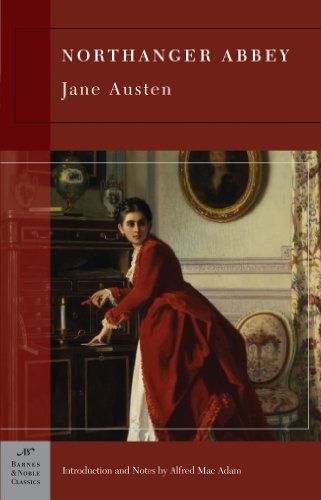
The only Jane Austen book I ever found myself truly enjoying was Sense & Sensibility. I read it two summers ago and actually fell in love with the characters of Elinor and Marianne. For once, two Austen characters I could identify with! That summer, I found myself enthralled with an Austen, which I had never thought possible. Sense & Sensibility revived my interest in Austen and made me resolve to read and re-read more in the future. Several weeks ago, my "classics itch" set in with the onset of cooler weather and I decided on Northanger Abbey as my classic of choice. With only two more Austen's to read, I settled on Northanger because my sister, whose judgment on books I trust wholeheartedly, had enjoyed it.

Photobucket

Remind me to always listen to my sister. Not only was Northanger Abbey enjoyable, it literally made me laugh out loud on more than one occasion. Yes, the plot follows a similar thread as Austen's other works, but the difference for me lay in the character of Catherine and the tone of the writing. For the first time, I felt like Jane Austen was fully present, as if I was eavesdropping on a conversation, not reading a published work. She was not invisible within the work, but right there with me, providing witty comments and often extremely humorous and even snide comments about the characters or the circumstances. I found myself thrilled to travel with her from Fullerton to Bath to Northanger, my 19th century travel companion. How could I have ever thought her boring and predictable before? Here she was, in the flesh, each tongue-in-cheek comment leaving me in a small fit of giggles.

For instance: “She was heartily ashamed of her ignorance - a misplaced shame. Where people wish to attach, they should always be ignorant. To come with a well−informed mind is to come with an inability of administering to the vanity of others, which a sensible person would always wish to avoid. A woman especially, if she have the misfortune of knowing anything, should conceal it as well as she can.” 

Or this one:  “Yes, novels; for I will not adopt that ungenerous and impolitic custom, so common with novel-writers, of degrading, by their contemptuous censure, the very performances to the number of which they are themselves adding; joining with their greatest enemies in bestowing the harshest epithets on such works, and scarcely ever permitting them to be read by their own heroine, who, if she accidentally take up a novel, is sure to turn over its insipid pages with disgust. Alas! if the heroine of one novel be not patronised by the heroine of another, from whom can she expect protection and regard? I cannot approve of it. Let us leave it to the reviewers to abuse such effusions of fancy at their leisure, and over every new novel to talk in threadbare strains of the trash with which the press now groans. Let us not desert one another- we are an injured body.” 

And finally: “I read it [history] a little as a duty, but it tells me nothing that does not either vex or weary me. The quarrels of popes and kings, with wars or pestilences, in every page; the men all so good for nothing, and hardly any women at all — it is very tiresome: and yet I often think it odd that it should be so dull, for a great deal of it must be invention.” 

These don't include the myriad of other slight "asides" slipped into a conversation or a description that caught me completely off-guard but really did delight me in the reading of them.

Because of Catherine, because of Northanger, I can now say that I really am a Jane Austen fan. In one short book, I feel as though I came to know her intimately as a writer, a woman, and a person. The plot is good and the characters interesting, but the writing is what really swept me away. I think I'm going to have to make a new spot on my shelf.

What's your favorite Jane Austen? Is anyone else a Jane Austen convert, like I am? Which book converted you? I'd love to know!

Tuesday, October 16, 2012

A Birthday

Currently Reading: Brooklyn by Colm Toibin

A quick post this morning, in between homework, cooking, and getting ready for work. It is simply beautiful outside- bright autumn morning sunlight glancing off of our balcony, a chill breeze blowing the leaves, and a perfect palette of blue sky against brown fields. I have never been able to get over how lovely it is outside in the fall. Driving to school on Monday mornings is a little bit dreadful (because I am so tired) but mostly amazing, as I literally watch the sun rise on the fields and barns dotting the land, transforming everything from the still, silent wakefulness that comes with the pre-dawn darkness to a world vibrant with color and light. In those moments, I feel closer to God in a way that is outside the liturgy of Church. It is difficult to explain, but I revel in the feeling of being so wholly alive. As Jane Eyre says, "We know that God is everywhere; but certainly we feel His presence most when His works are on the grandest scale spread before us."

Coincidentally enough, today is the 165th anniversary of the publication of my most treasured book-friend, Jane Eyre. You can read all about my relationship with, and musings over Jane Eyre in several past posts from June. To celebrate today, I'm pulling out some more of my favorite quotes:

"It is in vain to say that human beings ought to be satisfied with tranquillity: they must have action; and they will make it if they cannot find it."

"Now I remembered that the real world was wide, and that a varied field of hopes and fear, of sensations and excitements, awaited those who had courage to go forth into its expanse, to seek real knowledge of life amidst its perils."

Helen Burns to Jane: "Yet it would be your duty to bear it, if you could not avoid it; it is weak and silly to say you cannot bear what it is your fate to be required to bear."

Jane to Rochester: "I am no bird; and no net ensnares me; I am a free human being with an independent will, which I now exert to leave you."

165 years later, they still have such a powerful meaning, such relevance, so much emotion and truth within each line. 165 years from now, I know they will still have that same hold for future readers. Happy Birthday to a fantastic book. How will you celebrate today?


Thursday, June 28, 2012

Freedom through Expression

Currently Reading: Daughter of the Forest by Juliet Marillier (how obvious is my homesickness for Ireland?), and Bossypants by Tina Fey (best. audiobook. ever.)

You will see the title repeated a lot in this post. I'm just warning you.

As I wrote in last Wednesday's post, I discover something new every time Jane and I get together. This time, besides paying attention to and musing over the bird metaphors (which I may discuss in another post), I was completely struck by the underlying theme of freedom through expression. Actually, this does tie into the bird metaphors, as you will see in just a bit. (Warning: many, many spoilers below! If you haven't read Jane Eyre and want to be surprised, then immediately go find a copy, read it, and then revisit this post.)

Photobucket

The "freedom through expression" thing appears early in the novel- the first chapter, in fact. We discover that Jane, while an emotional child, has never before acted out, for her aunt is appalled at her behavior when she finally reacts against her abusive cousin. In that moment, Jane remembers, "It seemed as if an invisible bond had burst, and that I had struggled out into unhoped-for liberty." Through her reactions, by expressing her deepest self, she is finally free to assert herself and take control of the situation- a small victory for ten year old Jane, but an event that ultimately changes the course of her life.

Throughout the rest of the novel, Jane's life and victories follow this pattern, in large and small ways. For instance, Jane realizes her freedom to escape Lowood and discover her own path when she is honest with herself and mentally "soliloquized" her restlessness and desire for action. Jane also discovers freedom through expression in her growing friendship and then love for Mr. Rochester. From their very first conversation at Thornfield Hall, both discover that they are free to express themselves to the other. Around Jane, Rochester does not need to wear the facade he does around his aristocratic friends; Jane does not have to hide quietly in the shadows, never considered and never free to honestly express herself. While Jane is a very passionate person, she has had to learn to keep her emotions and thoughts within herself, for she never had someone in whom she could confide. Yet with Rochester, she discovers, "he is not of their kind. I believe he is of mine;-I am sure he is,- I feel akin to him,- I understand the language of his countenance and movements; though rank and wealth sever us widely, I have something in my brain and heart, in my blood and nerves, that assimilates me mentally to him." Trust and respect play an equal part in the growth of their friendship and love for the other, fed and nurtured by open communication and the slow revealing of their souls.

Despite her attempts, Jane's love for Rochester does not stay secret; on a stormy night in a garden, (one of the best scenes in the book) she finds freedom only in expression, thereby breaking the last barrier between herself and the friend with whom she has fallen in love. Jane describes the moment perfectly: "The vehemence of emotion, stirred by grief and love within me, was claiming mastery, and struggling for full sway; and asserting a right to predominate: to overcome, to live, rise, and reign at last; yes- and to speak." No longer a bird ensnared in a net or trapped in a cage of her own making, she finally gains a sense of liberation and equality with Rochester in speaking and asserting her love for him. Having done so, she declares that she will leave him, rather than watch him marry another. When he objects, she passionately declares, "I am a free human being with an independent will; which I now exert to leave you." Only in expression does she feel she is truly free to decide her own destiny- which she continues to do throughout the rest of the novel.

Rochester too is a trapped bird, though in other ways than Jane is. Trapped by circumstance rather than feelings, he sees the entrance of Jane into his life as a way out of the existence he has been forced to lead and onto a path to better himself. This is a delicate piece of the book, and one that most readers seem to misunderstand. I have heard many statements about Rochester's cruelty for deceiving Jane or leading her on, for like St. John, many assume that he is a bad man with bad motives. But he isn't. He is merely a man, hemmed in by unhappiness and hopelessness, who finds the peace and happiness he lost so long ago, the keys to the cage that has kept him trapped for so long, in the form of a remarkable woman, his inferior in society but his equal in his soul. He recognizes that Jane's presence has the power to reform him, and he sees a transformation within himself because of her influence. He is a man with a good soul, but he is the product of a desperate, hopeless life. Trapped inside the walls of Thornfield, inside his secrets and lies, he discovers that loving Jane provides the freedom he has so long craved. His love for Jane is his liberation, but he tries to force the lock too early, impatient to stretch his wings. It is only after he has "walked through the valley of the shadow," and fallen on his knees in desperation to God, that he too finds freedom in expression. "That I merited all I endured, I acknowledged- that I could scarcely endure more, I pleaded; and the Alpha and Omega of my heart's wishes broke involuntarily from my lips in the words- 'Jane! Jane! Jane!" Through his cry for Jane, he receives the freedom he has sought for so long, because though they are miles apart, in the depths of their souls they both hear and respond to the other. Freedom through expression indeed.

Photobucket

Jane and Rochester constantly struggle for liberation throughout the book: liberation from their past, their social status and obligations, and the influence of others. And here is the most beautiful part: each of them serves to liberate the other. Their relationship is the "freedom through expression" theme in action. With St. John, who is presented as a contrast to Rochester in the novel, Jane found herself once again trapped, for "he acquired a certain influence over me that took away my liberty of mind...I could no longer talk or laugh freely when he was by..." St. John was the type of man who stifled her sense of self. In comparison, Rochester is her soul's mate because he encourages her freedom of expression and loves her for exactly who she is. She is free to be herself when she is with him; in a very modern throwback from Charlotte Bronte's world in 1847, marriage to Rochester actually gives Jane more independence than she has ever known, an independence of the soul, as well as the body. As Jane ends the book, "To be together is for us to be at once as free as in solitude, as gay as in company. We talk, I believe, all day long: to talk to each other is but a more animated and an audible thinking." Through open communication, through expression, comes trust, respect, and equality. Many women at that time could only dream of such a partnership; thankfully, Jane's and Rochester's once unattainable relationship has now become reality for so many of us. I see Jane Eyre, then, as Charlotte Bronte's own personal act of freedom through expression. Through her written words, she was free to create characters that fell outside the norm of her day; she gave them lines of dialogue that represented her own feelings. Like many other women writers of her time, her novels were the keys to her own cage.

For anyone else who has read Jane Eyre, what is it that you love most about the book? I would love to hear your thoughts!

Wednesday, June 20, 2012

Flesh and Blood

Currently Reading: Inventing Ireland by Declan Kiberd, On Celtic Tides by Chris Duff, and Bossypants by Tina Fey

Unless it's a textbook, I usually don't write in the margins when I read. I have never felt comfortable with doing so. I like to keep the book pure, for it seems almost as if I am desecrating another's work when I add my two cents. Yet as I started out on this reread of Jane Eyre, I practically felt drawn to record my thoughts and note the details as I read. Perhaps this is because I have read it so many times or because I was looking forward to the experience so much that I wanted to preserve it in some way. Regardless, I chose a copy from my shelf that I didn't mind writing in and set to it. I read for pleasure, getting lost in the music of the words and savoring every bit of the world which I love so much. But this time, I also read to take note of the deeper themes and nuances of the book- the symbolism of birds, the themes of independence and freedom, the meaning behind the talk of fairies and the supernatural, the true characters and personalities of the main players- all things I have noticed and written about and pondered before, but this time fixing my thoughts right on the page alongside the printed words.

I finished it tonight. Over time, I have noticed that each time I read Jane Eyre, something new speaks to me or I notice something I never did before or I understand something that previously eluded me. One year, after meeting and falling in love with my then-boyfriend, now-husband, I cried tragically at the scene where Jane leaves Rochester. Never before had I cried at that, but never before had I really been in love and so I could not empathize with the pain in Jane's heart or the willpower it took for her to take one more step away from he who loved her. Yet at that stage in my life, and forever after, I have felt that scene strike me in the gut and I always come away shaken.

This time, my new reading experience was eye-opening.

Like many other women (I assume), I tend to fall into the nasty habit of comparing my life and myself to others. And not in the material, "I wish I had her car" kind of way, but in a "I wish I was as optimistic as she is" or "I wish I could be so confident" or "How come she can seem to get everything done and I can't" sort of way. I second-guess myself, I am quick to point out my faults, and I seem to find the ideal in everyone else around me. Or in a book. For years, Jane Eyre has been my hero. To an eleven-year-old kid (heck, even to a twenty-four year old adult), she is a woman to admire, a woman of so many pure qualities that after twelve years of idolizing her, she no longer seemed human. Ridiculous, isn't it?

For me, this past year has been one intense learning opportunity and I have simultaneously embraced and fought it. More than ever, I feel as if I am in the process of discovering exactly who I am and what I am capable of- while also recognizing and addressing my faults as well as learning to accept the things I cannot change about myself. (Whew!) So perhaps it is because I feel like I have grown as a woman since my last reread in the summer of 2010 that I truly, for the very first time, saw Jane for exactly who she is.... and found her not to be perfect, but to be my equal. There are faults within her, and doubts, and mistakes. She is not a quiet-tempered angel but a fiercely passionate, emotional woman who doubts herself, and has regrets, and gets confused. She sits in her room and practically broods over her decision to leave Thornfield, paralyzed with fear that her actions ruined a man's life; for one agonizing hour, she sincerely doubts Rochester's love for her. She knows herself and has strength beyond measure, but is also capable of being intimidated and influenced, as she was with St. John. She can be frightened and she can lose her nerve to speak. Even when comfortable, she can be restless, wishing herself elsewhere, envisioning a different life. These things don't make me love her less; instead, they make me love and understand her even more. How have I missed these obvious and beautiful depictions of a real woman, one who is not so much different from myself and many others I am privileged to know? Here is a flesh-and-blood woman, with positive and negative qualities, one who has such a capacity to love- who is compassionate, loyal, quick-witted, a hard worker, and one who speaks her mind. A woman like any other, who is guided by reason but who also lets emotion and passion dictate her actions. A woman like me.

This book is truly an Aladdin's cave, a treasure trove of ideas and inspirations and revelations that are always fresh and new to my thirsty mind. I revel in it. And in Jane.

More to come on various themes and symbolism- oh, I had such a wonderful time!

Tuesday, June 12, 2012

Jane and I.... A Twelve Year Love Affair

Currently Reading: Inventing Ireland by Declan Kiberd and Jane Eyre by Charlotte Bronte


I was eleven. My sixth-grade class that year was doing a reading challenge, where we recorded all of the books we had read on a giant chart, so that we could see how many we read by the end of the year. For whatever reason, I took the challenge quite literally and really strove to challenge myself. I still don't know why I got it into my head to find the biggest, thickest books on the school bookshelf with the biggest, longest words. It's not like I still didn't enjoy Babysitters Club or other small chapter books, designed expressly to be read by children my age. While I don't remember the inspiration that drove me to check out Great Expectations, or Dr. Doolittle, or Wuthering Heights, I did. And while my little head could not understand every word or plot point or character development, it took in enough to realize that there was so much to discover beyond the books I had read before. None of the three books I mentioned above became favorites. In fact, I have never reread them (although I tell myself I should. I have no doubt it would  be like culture shock, to reread something as an adult that I only ever experienced as a child.) Yet one classic stuck. And her name is Jane Eyre.

About a year ago, I revisited my old grade school's library and found the copy I first read, sitting there still on the shelf. Small in size, the words are printed tight together on browning pages. The cover is white with a blue border; a drawing of a woman in period dress stands in the foreground, while behind her is a man on a horse. I am an avid collector of copies of Jane Eyre and my bookshelf has a beautiful assortment, ranging in size and color, publication dates stretching from the early 20th century to the present. Yet this is the copy I would love to have over all others (except an 1847 first edition. If you have one of those, let me know!), for it is my original, the one where I first discovered Jane, and Thornfield, and Rochester. In that copy, I found my favorite place, the book that spoke to me above all others, even at a young age. I know others have checked it out after me, but the memory of my first discovery must still be nestled somewhere in those pages, held there indeterminately.  I held the little tome in my hand, showing it to my husband, who (bless his heart) has always appreciated and understood this love affair of mine. It felt so right, as if I was reliving a memory and found everything as I had left it, perfectly waiting for me.

Looking back, I can't remember what prompted my small self to notice the book or grab it from the shelf or take it home but I knew that I fell in love instantly. Inexplicably, at the age of eleven, something in my soul recognized a piece of itself, kept within a book cover, hidden on a shelf. And whenever I pull a copy from my shelf and start reading again, the anticipation and excitement that follows is the same as it was even then. Twelve years later, I view Jane Eyre as a friend, a home, a place familiar and welcoming to me, yet also a place where I never cease to discover something new with each visit. Our love affair is still going strong.

Photobucket
Me and Jane on my wedding day, one year ago, at the hair salon. 

I have so much to share about my newest experiences rereading Jane Eyre and I look forward to writing about my favorite book on my blog. I already have so many notes and thoughts, just waiting to be shared. P.S. Just for fun, did you know the background on this blog is a picture I took of several of my Jane Eyre copies opened and spread out on the table? :) I thought you would like to know!

Sunday, April 29, 2012

Snapshots

Currently Reading: One Thousand Gifts by Ann Voskamp

Let me set the mood, for my current scene is too delicious not to share. I am home alone, waiting impatiently for Nate to come. The steady sound of rain hitting roof serenades the quiet and is only accompanied by the clacking of keys and the tick of our clock. Hobbes crouches on the desk next to me, intent and watchful. It's quiet, semi-dark, as rain drips patterns on our sliding glass door and the day outside slowly becomes night. This moment is peaceful, perfect for reflection, which is the mood I have been carrying with me all day. If moods had colors (true Mood ring style), what would "reflective" be? Soft gray, like the rain clouds in the sky? Sepia-toned, with that hint of nostalgia and memory? The bright yellow of lamplight? Today it might be a little of each. With thoughts winging and soaring around my head, I plan to let them land where they will.
~~~~~~~~~~~~~~~~~~~~~
Eden's Outcasts is still with me, even several weeks later. It is a difficult task to tell the story of another's life and John Matteson did a phenomenal job. Most of the time, I forgot I was reading someone else's words and analyses, which is the mark of a great writer- to slip invisible beneath the pages. While reading, I often found myself wondering about what Louisa's life would have been like if she had lived in the present day- would she have still accomplished what she did? Would she have lived longer? Would her family life have been the same? It is interesting to think how much of our personalities, accomplishments, and failures are products of our times as well as our natures. The same holds true for her father. Bronson was a figure of his time- what would his philosophies and educational doctrines have been away from Transcendental Concord? The book was a wonderful amalgam of a discussion of two individuals who both exercised great influence over the other. The final sentence of the book is quote-worthy: "As writers, as reformers, and as inspirations, Bronson and Louisa still exist for us. Yet this existence, on whatever terms we may experience it, is no more than a shadow when measured against the way they existed for each other."
~~~~~~~~~~~~~~~~~~~~~
Nate's home! Time to make some dinner.....
OK, I'm back. Swedish meatballs in the oven and I'm ready to go...
~~~~~~~~~~~~~~~~~~~~~
 
As of last week, I was a James Joyce virgin. But since our Ireland trip is coming ever closer, I decided I needed to dip my toes into one of Joyce's works. Dubliners it was! I enjoy reading short stories, although I don't always do so. (Kate Chopin's "Story of An Hour" is still my favorite short story to date.) Dubliners was like an arc, starting with a story from a child's perspective and ending with a character in late middle age. The first and last story also contained a death of sorts, bringing the collection of stories full circle, like the sun traveling east to west. Another unique characteristic of Dubliners was that each tale acted as a snapshot, a still-life painting of a pivotal moment or moments in the main character's life and understanding of self. Only one story opened with any sort of description of the character or surroundings; the rest simply dropped the reader into a thought or an action, as if we inadvertently time-traveled to this particular scene, with no history of what came before and no idea where we are, or snuck into a movie halfway through. Far from disconcerting, it was exciting. It forced me to pay attention to detail and learn the situation by reading into the character's dialogue or facial expressions. And what a rich cast of characters! Each were confronted with truths about themselves and their lives, forced to perceive their existence in a new way. Some encapsulated a night or a few days, others captured moments, mere glimpses of an hour. All of the stories was new and different, with no air of staleness or crustiness. One would never know it was written almost 100 years ago. While I feel I learned even more about early 20th century Ireland through this telescope of stories, I also think Dubliners accurately examined all human nature and human experience, regardless of time or place. It was definitely worth the read and I feel pleased for having read it. Joyce has always been on my list and while I have never been brave enough to tackle Ulysses, I look forward to diving into the Joyce canon a little more fully in the future. Favorite stories from Dubliners: "Eveline", "The Boarding House", "A Painful Case", and "The Dead". All very different, but all worth great reflection.
~~~~~~~~~~~~~~~~~~~~
Hobbes is trying to catch the raindrops that slide down the exterior of the door. So cute, so futile. I love that cat. And now I end an enjoyable weekend, one spent savoring my final (for now) sleepover with one of my best friends, since she moves away in two weeks. Goodbyes are never easy and this one is especially difficult, for we have shared six years of adventures and laughs and soul-baring. But I must remind myself that I am blessed to have someone to miss. Missing someone means you are loved and have loved in return. A new chapter begins.

Keep On Reading...

Related Posts Plugin for WordPress, Blogger...